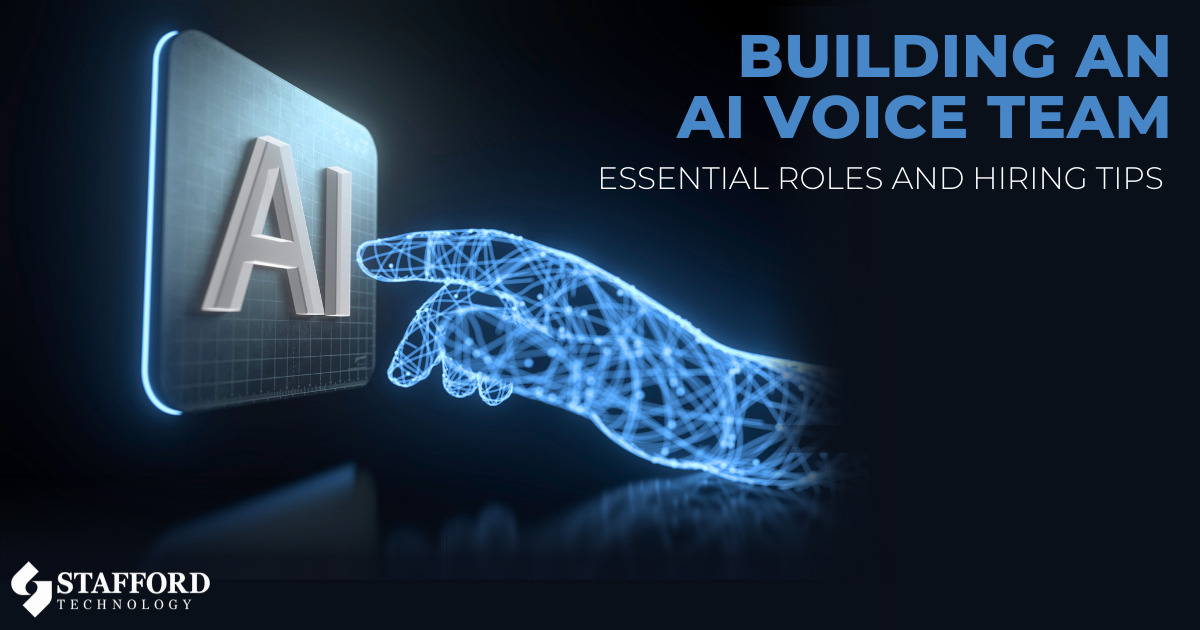

As AI voice and conversational technologies develop, they’re changing how organizations connect with customers and improve digital experiences. As these technologies gain wider adoption, companies must build the right team to advance their AI initiatives.
Stafford Technology understands that people are the most crucial element in advancing a business and bringing essential emerging technologies to life. Whether you’re creating a voice assistant, automating customer interactions, or exploring new communication methods, Stafford Technology helps you build the skilled, culturally aligned team needed to succeed.
This guide breaks down the key roles needed for successful AI voice projects and shares insights on how to enhance your talent strategy.
Why Do AI Voice Experts Matter?
The impact of artificial intelligence on our work is significant, and voice technology is accelerating this evolution. We’re moving beyond traditional customer service and basic chatbots to a more engaging phase where customers can converse with businesses in a way that feels genuine and personal.
Voice-driven AI makes these interactions faster, more accurate, and more natural. Harnessing this technology enhances communication and builds stronger customer relationships through better service.
Bringing AI voice talent on board isn’t just about staying on-trend; it’s about enriching user experiences and fostering authentic connections with people. For organizations focusing on building lasting relationships, this shift is transformational.
What Are the Key Roles on an AI Voice Team?
1. Conversational AI Architect
A Conversational AI Architect is crucial in crafting your voice technology. You combine elements such as natural language processing, speech recognition, and dialogue management with backend systems to deliver smooth user experiences.
When searching for the right candidate, look for someone experienced with platforms like Rasa and Dialogflow. They should have a solid grasp of machine learning architecture and examples of successful conversational solutions they’ve implemented. Importantly, they need to connect technical designs to your business goals to ensure everything aligns effectively.
2. Natural Language Processing (NLP) Engineer
As an NLP Engineer, you are at the heart of what makes engaging, conversational AI. You translate raw, human language into something machines can comprehend and respond to, shaping how naturally and intelligently the system interacts.
Ideal candidates will have direct experience with transformer models, strong Python skills, and proficiency with prominent NLP libraries.
3. Voice User Interface (VUI) Designer
A VUI Designer customizes voice interactions and creates dialogues that feel intuitive and friendly to users when they are engaging with AI. It’s not just crafting prompts; it involves designing an experience that guides, supports, and delights users.
What’s changed? It’s not just about creating prompts; it’s about designing an experience that guides, supports, and delights users.
The best VUI designers anticipate user needs, then adjust to natural speech patterns, and create seamless interaction flows. They have a deep understanding of conversation design principles and experience in voice-first environments. Be on the lookout for a strong portfolio that showcases detailed user research and usability testing.
4. Machine Learning Operations (MLOps) Engineer
MLOps Engineers ensure that machine learning models function smoothly in the real world. You facilitate the journey from experimentation to production, guaranteeing models are stable, scalable, and user-ready.
For this role, look for candidates with expertise in tools such as Docker and Kubernetes, as well as experience in model monitoring, versioning, and automated testing and deployment. The best MLOps engineers blend engineering expertise with operational reliability, which is essential for maintaining the performance of your conversational AI.
5. Speech Recognition Specialist
Speech Recognition Specialists enable conversational AI to understand spoken language. You convert speech into accurate text, a challenging task that involves navigating accents, background noise, and the nuances of natural speech.
If you’re looking for a Speech Recognition Specialist, prioritize those with extensive experience in acoustic modeling and familiarity with automatic speech recognition technologies. Their skills are crucial to creating a seamless, enjoyable user experience.
6. Data Annotation Specialist
In conversational AI, Data Annotation Specialists are critical team members who ensure clean, well-structured, high-quality data when training AI models. Other tasks include labeling audio, transcripts, intents, and other essential inputs that enable the AI to engage and evolve. Without your expertise, even the most advanced AI systems can struggle to perform effectively.
Highly effective candidates for this position have a keen eye for detail, a commitment to consistency, and a strong understanding of language nuances. Look for individuals who truly appreciate how their contributions enhance the system’s overall intelligence.
7. Conversational Content Writer
As a Conversational Content Writer, you shape the AI’s personality and clarity. You create responses that feel natural, concise, and genuinely helpful, crafting a voice that users find easy to interact with and enjoy.
The best candidates for this type of content writer role understand the intricacies of conversation design and can anticipate user questions before they arise. Collaboration is key; this role works closely with designers and engineers to ensure that dialogues support the user journey seamlessly. This role combines creativity with strategy to create conversations that resonate with users, even when powered by machines.
8. AI Ethics and Compliance Officer
As conversational AI becomes part of our daily lives, the role of an AI Ethics and Compliance Officer is critical. In this position, you’ll ensure AI systems operate responsibly and transparently, in compliance with ethical and regulatory standards.
A successful candidate has a solid background in data privacy laws, a keen understanding of responsible AI practices, and an unwavering dedication to protecting users’ rights. The ideal individuals in this role not only help organizations innovate but also do so in a manner that maintains user trust and confidence.
9. Customer Success Manager – AI Solutions
As a Customer Success Manager in AI, you blend relationship-building skills with a strong technical understanding to guide customers in making the most of their conversational tools. You distill the complex features of these tools into tangible benefits, ensuring customers feel supported and confident as they embrace new technology.
Excellent candidates for these roles excel at building trust, can articulate both the strengths and limitations of AI tools, and know how to guide teams through transitions. Great CSMs use customer insights not just for product improvement but also to create long-lasting advocates who genuinely believe in what you’re offering.
10. Voice AI Product Manager
As a Voice AI Product Manager, you drive the strategy, roadmap, and execution of voice experiences. Your role involves balancing cutting-edge technology with user needs.
When looking to fill this position, seek candidates who are well-versed in the industry landscape, can communicate effectively across various teams, and have a proven history of launching AI-driven or voice-enabled products. They should be adept at integrating emerging market trends, technical capabilities, and customer feedback into a coherent product vision. The strongest candidates combine business acumen with technical knowledge and a deep understanding of user experience, ensuring every product decision propels the organization forward.
By bringing these roles together, your AI voice team can drive truly engaging, efficient interactions that transform how your organization connects with customers.
Building Your Team: Strategic Hiring Tips
Tip #1: Focus on the Essential Roles First
Start by filling core roles such as NLP Engineers, VUI Designers, and Conversational AI Architects to build a solid foundation before expanding into more specialized areas.
Tip #2: Mix Specialists with Generalists
Having team members who can work across disciplines fosters collaboration and sparks creativity. For example, designers with a grasp of data can create more holistic and practical solutions.
Tip #3: Plan for Growth
Your team should evolve alongside your AI roadmap. Look for chances to develop talent internally and share learning opportunities, so your team can grow with technology.
Tip # 4: Encourage Continuous Learning
The AI landscape is constantly changing. Offer support for ongoing education through training, certifications, and attending conferences to keep skills fresh and innovative.
How Do I Find AI Voice Talent?
Finding the right professionals in the AI voice domain can be challenging, but here are some effective strategies:
Explore Niche Communities
Engage in groups that focus on AI and voice technology. Connect with skilled individuals and enhance your knowledge while expanding your professional network.
Attend Industry Events
Participate in conferences and meetups to network with peers and industry leaders. These gatherings are valuable for learning about new trends and identifying potential candidates.
Look for Related Skillsets
Consider professionals from related fields, such as linguists moving into NLP or UX designers transitioning to VUI, who may bring transferable skills to your team.
Partner with Specialized Recruiters
Collaborate with niche recruiting firms that focus on the tech and AI sectors to help streamline your search for the right talent.
Building the Future Starts with the Right Team
In today’s lightning-speed technological landscape, adopting AI is no longer optional; it’s essential. Organizations need to embrace AI voice technology and intentionally invest in their employees to provide an optimal user experience and flourish. Building an AI voice team isn’t just about hiring the right people; it’s about fostering a collaborative environment where teams can come together, share ideas, and tackle challenges creatively to enhance user experiences. If you’re eager to develop effective talent strategies and nurture a strong team, Stafford Technology is here to guide you in creating a workforce that will pave the way for a prosperous future.
Are you ready to build your AI voice team? Visit
https://www.stafford-technology.com/ and get started in your search for the right AI voice candidates or find your dream AI voice job.
#image_title