
Here’s something we hear from candidates all the time:
“I just need to get the interview. Once I’m in the room, I’ll figure it out.”
We understand the thinking. Getting an interview can feel like the hard part.
But we’ve worked with enough IT professionals over the years to know that’s not always the case.
Some of the strongest candidates we meet have solid technical backgrounds, good experience, and resumes that get attention. Then they sit down for an interview and struggle to explain what they’ve actually accomplished.
It’s frustrating because the problem usually isn’t a lack of qualifications.
The problem is communication.
If an interviewer leaves the conversation unsure about what you contributed, how you solved problems, or why your work mattered, you may not get credit for the experience you’ve already earned.
That’s one reason the S.T.A.R. method remains such a useful interview tool.
So, What Is the S.T.A.R. Method?
The S.T.A.R. method gives you a simple structure for answering behavioral interview questions.
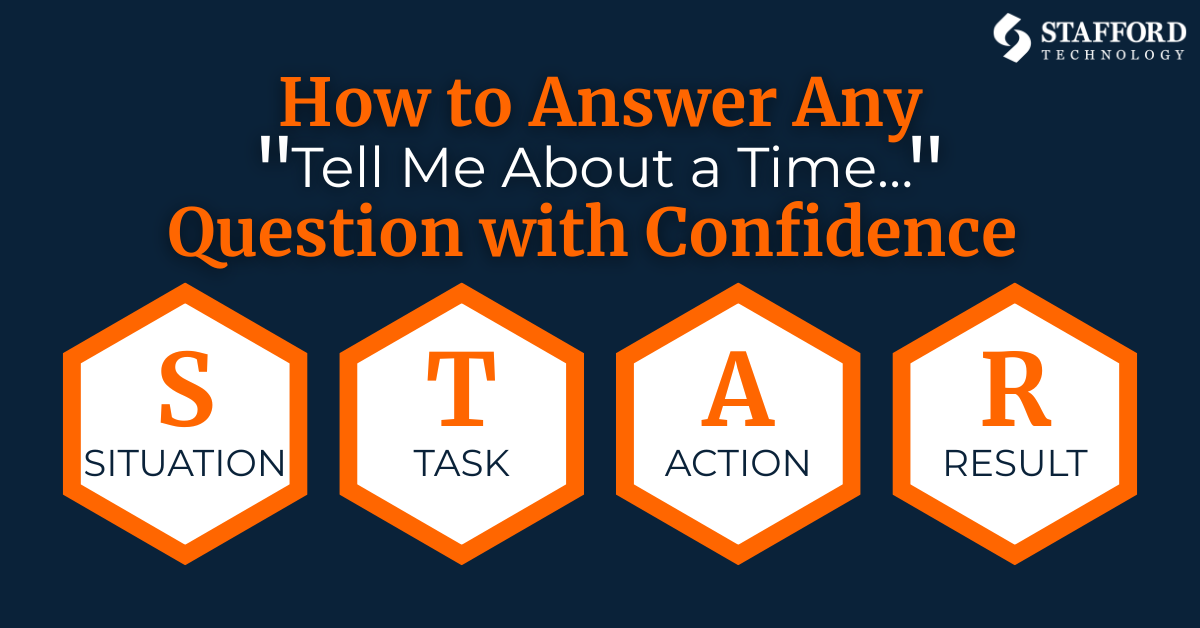
S.T.A.R. stands for:
Situation: What was happening?
Task: What were you responsible for?
Action: What did you do?
Result: What happened afterward?
That’s it.
At its simplest, S.T.A.R. helps you tell a complete story instead of offering scattered details and hoping the interviewer connects the dots.
Most hiring managers aren’t looking for a perfect answer. They’re trying to understand what happened, what role you played, and what came from your efforts.
S.T.A.R. makes that easier.
Why Hiring Managers Ask Behavioral Questions
Almost everyone has heard questions like:
“Tell me about a time you had to solve a difficult problem.”
“Describe a disagreement you had with a coworker.”
“Tell me about a project that didn’t go as planned.”
Candidates sometimes dislike these questions because they can feel repetitive.
Hiring managers ask them because they’re useful.
Anyone can say they’re a good communicator or a strong problem solver. Behavioral questions give interviewers a chance to hear evidence instead of claims.
They’re trying to understand how you operate when things get messy, deadlines get tight, or projects don’t go according to plan.
The people who do well in these conversations aren’t always the most experienced candidates in the room.
They’re often the people who can explain their experience clearly.
Using S.T.A.R. Without Sounding Scripted
One mistake people make is treating S.T.A.R. like a script.
It isn’t.
You don’t need twenty memorized answers.
You just need a handful of real examples that you’re comfortable discussing.
Think of S.T.A.R. as a guide rather than a formula.
Situation: Give Enough Context
The interviewer needs a little background before the story makes sense.
The key phrase is “a little.”
A surprising number of candidates spend several minutes setting up a story before they get to the actual point.
Something like this is usually enough:
“At my previous company, our systems were slowing down during peak traffic periods, and customers were starting to notice.”
Once the interviewer understands the situation, move on.
Task: Explain What Was Yours to Own
This part matters more than people realize.
Candidates often describe what the team accomplished, but never explain their specific role.
An interviewer can only evaluate your contribution if they understand what it was.
For example:
“I was responsible for identifying the cause of the issue and recommending a solution.”
Short. Clear. Easy to follow.
Action: Spend Most of Your Time Here
This is where interviewers learn how you think.
Compare these two answers:
“I worked on improving system performance.”
Versus:
“I reviewed system logs, identified a bottleneck in several database queries, worked with the engineering team on optimization, and helped roll out the changes in stages so we could monitor the impact.”
The second answer tells the interviewer far more about your skills and decision-making process.
Details matter here.
Result: Finish the Story
This is the part candidates leave out most often.
They explain the problem.
They explain what they did.
Then they stop.
Interviewers are left wondering whether the solution actually worked.
Always include the outcome.
“After the changes were deployed, downtime during peak traffic periods dropped by roughly 40%, and customer complaints decreased noticeably.”
That’s the piece that ties everything together.
And whenever possible, include numbers.
They don’t have to be perfect. Estimates are fine.
Specific outcomes tend to be more memorable than general statements.
What a Good S.T.A.R. Answer Looks Like
Question: Tell me about a time you solved a technical problem.
“At my last company, we were dealing with load-time issues during high-traffic periods, and it was beginning to affect customer experience. I was responsible for figuring out what was causing it and leading the effort to fix it. After running load tests, I traced the issue to several inefficient API calls and redesigned part of the backend workflow to reduce unnecessary requests. Within a few weeks, load times improved by about 35%, and we started seeing engagement numbers recover.”
Notice what makes this answer effective.
It’s specific.
It clearly explains ownership.
It focuses on actions instead of buzzwords.
And it ends with a result.
Nothing fancy. Just clear.
Common Mistakes We See in Interviews
Being Too Vague
Statements like:
“I helped with that project.”
or
“I was involved in that initiative.”
Don’t tell an interviewer much.
If you played an important role, explain what that role was.
Taking Too Long
Most interview answers don’t need to be five-minute stories.
If you’ve spent several minutes talking and still haven’t reached the outcome, you’re probably including details that aren’t helping you.
Forgetting the Result
This happens constantly.
Candidates explain the challenge and the work they did, then move on to the next question.
Don’t make the interviewer guess whether the effort was successful.
Tell them.
Skipping the Numbers
You don’t need perfect metrics.
But if you know that a process became faster, costs went down, uptime improved, or customer satisfaction increased, include it.
Those details help interviewers understand the impact of your work.
How to Prepare Without Overdoing It
You don’t need dozens of stories.
Most people can cover a wide range of behavioral questions with five or six strong examples.
Think about situations where you:
Solved a difficult problem
Worked under pressure
Improved a process
Resolved a disagreement
Learned from a mistake
Led an initiative
Write down the basics of each story and practice talking through them.
Out loud.
Not in your head.
There’s a huge difference.
You’ll quickly notice where you’re rambling, where details are missing, and where parts of the story don’t flow the way you thought they did.
A little practice goes a long way.
A Quick Note for Technical Professionals
We’ve seen plenty of highly skilled developers, engineers, and IT professionals struggle in interviews.
Not because they lacked expertise.
Because they assumed the quality of their work would speak for itself.
Interviews don’t work that way.
The person across the table may not understand every technical detail of what you’ve built.
What they can evaluate is how you think, how you communicate, and whether you can explain your work in a way that others can understand.
That’s one of the biggest advantages of the S.T.A.R. method.
It helps translate technical accomplishments into stories people can follow.
How We Help Candidates Prepare at Stafford Technology
Interview preparation is something we take seriously.
When we’re working with candidates, we spend time discussing what employers are actually looking for, how interview processes tend to unfold, and which experiences are likely to resonate most with hiring managers.
The goal isn’t to manufacture polished answers.
It’s to help people tell their own stories more effectively.
If you have an interview coming up and want another set of eyes on your approach, we’d be happy to have a conversation.
Explore Job Seeker Resources → https://www.stafford-technology.com/job-seekers/