
In Columbus, a self-taught developer has built applications, contributed to open-source, and quickly learned new frameworks.
Yet, your current hiring process overlooks them.
Not because of lack of ability or discipline, but because your job posting still says: “Bachelor’s degree required.”
That single line can filter out strong candidates before they ever reach your team. In a tough hiring market, that is more than a missed opportunity; it is a very real hiring risk.
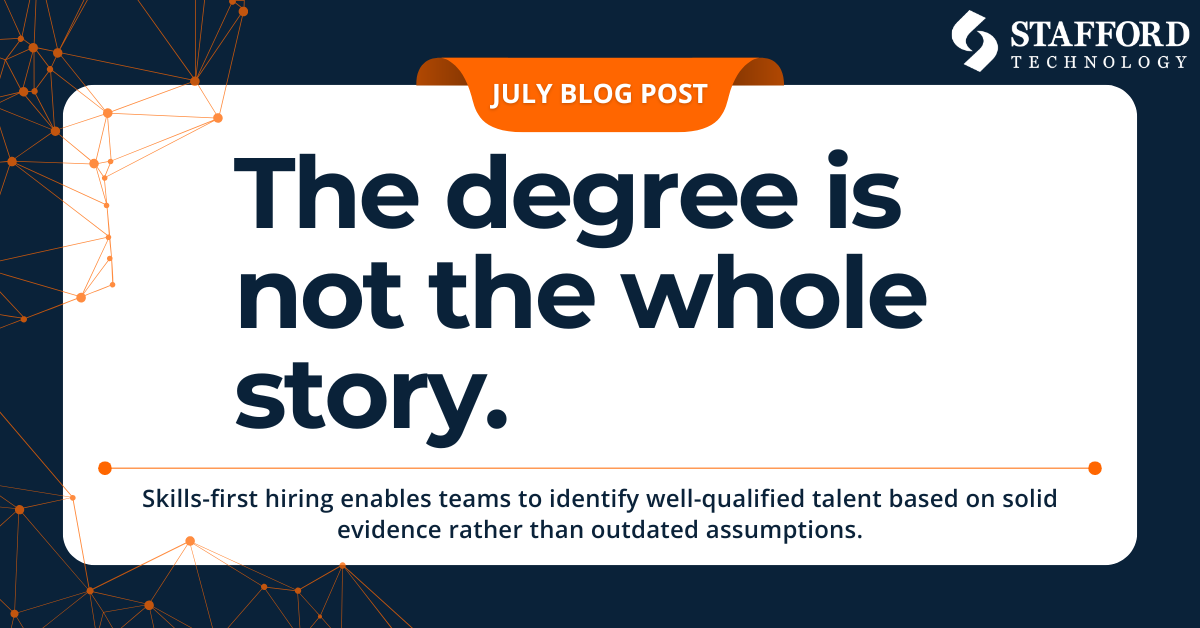
That’s why more organizations are considering skills-first hiring.
Rather than leading with the requirement of holding a four-year degree, skills-first hiring starts with a more practical question: Can this person do the work, solve real problems, communicate clearly, and keep growing with the team?
Stafford Technology believes a resume matters, but it is never the whole story. The better question is simple:
Can this person succeed in your environment?
The Degree Requirement Is No Longer Enough
Degrees can signal persistence, exposure to theory, and commitment. They still matter in some roles.
But in technology, they are not the only path to capability.
Cloud platforms evolve. AI shifts workflows. Security needs grow. Development frameworks change quickly. A curriculum built four years ago cannot always keep pace with the work that needs to be done today.
Meanwhile, demand remains strong. The U.S. Bureau of Labor Statistics projects computer and information technology occupations to grow much faster than average from 2024 to 2034, with about 317,700 openings each year.
That demand cannot be met only by traditional degree pipelines.
The better path is not to ignore education. It is to widen the lens.
Strong Talent Comes From Many Pathways
Some of today’s most capable tech professionals arrive through less traditional routes.
Bootcamp graduates often bring recent, project-based experience and portfolios that show what they can build. Career changers may bring years of experience in business, operations, teaching, design, or project management into a technical role. Certified professionals can demonstrate current knowledge in cloud, cybersecurity, networking, or data tools.
Open-source contributors show something else entirely: real-world collaboration, code review, and problem-solving in public.
Then there are the self-taught candidates. They learned because they were curious. They broke things, fixed them, searched for better answers, and kept going.
That kind of motivation is difficult to teach and easy to overlook when your screening process starts with a degree checkbox.
Your Job Description May Be Shrinking Your Talent Pool
Many hiring teams do not intend to exclude great candidates. They are simply using old templates.
A typical entry-level developer posting might say:
“Bachelor’s degree in Computer Science or related field required. Two or more years of experience preferred.”
That may sound standard. But it filters for access as much as ability.
It can screen out the single parent who learned Python at night, the former teacher who completed a strong development bootcamp, or the freelancer with five years of client work and no traditional degree.
A skills-first version is more precise:
“You have built and deployed at least one full-stack application. You can explain your technical decisions, work comfortably with Git, write tests, and communicate clearly with a team. A portfolio, GitHub profile, certification, bootcamp experience, or professional project work can all help show us what you can do.”
That language invites capable candidates in and gives hiring teams better evidence to evaluate.
Skills-First Hiring Still Requires Strong Vetting
Dropping degree requirements is not enough.
Many companies get stuck after removing degree requirements by keeping the same shallow screening process in place. Then they feel overwhelmed by the number of applications and return to old habits.
Skills-first hiring works when the vetting process gets stronger, not looser.
At Stafford Technology, we look beyond the resume to understand the person, the work, and the fit. That includes technical conversations, practical assessments, portfolio reviews, reference checks, and careful evaluation of communication, teamwork, and cultural alignment.
The goal is not to take a chance on unproven talent. The goal is to identify proven talent through better evidence.
What This Looks Like in Practice
Imagine a Columbus health tech company searching for mid-level React developers.
Their original posting requires a four-year degree in computer science. After several weeks, the candidate pool is thin. The same familiar resumes keep circulating. Strong developers are already employed, and nontraditional candidates never make it past the filter.
Now, remove the degree requirement and replace it with clear competencies.
Suddenly, the team can consider a bootcamp graduate with two deployed applications and excellent communication skills. A self-taught developer with years of freelance React work. A candidate with an associate degree, cloud certifications, and strong production experience.
The standard did not drop. The evidence improved.
That is the heart of skills-first hiring. It does not mean “hire anyone.” It means stop using pedigree as a shortcut and start evaluating the skills that actually predict success.
How to Modernize Your Hiring Process
You do not need to rebuild everything overnight. Start with the places where degree requirements are doing the most damage.
Audit your job descriptions. Look for phrases like “degree required,” “accredited university,” or “GPA minimum.” Ask whether each requirement is truly necessary for the work.
Replace credentials with competencies. Instead of “BS in Computer Science required,” define the outcomes: build and deploy software, troubleshoot production issues, write clean code, collaborate in a development workflow, or explain architecture decisions.
Ask for proof of work. A GitHub profile, portfolio, case study, certification, bootcamp project, or relevant professional experience can reveal far more than a school name.
Update your technical screen. Realistic exercises, portfolio reviews, and structured technical conversations are more useful than trick questions or memory tests. Let candidates show how they think.
And if your team does not have the time or technical depth to vet candidates this way, partner with someone who does. A high-touch staffing partner can help you separate potential from noise and move faster without sacrificing quality.
The Real Risk Is Staying Too Narrow
One concern we hear often: “What if a nontraditional candidate does not know the fundamentals?”
It is a fair question. Some will not.
But the same is true of some degree-holding candidates.
The credential is not the person. A degree does not guarantee production-ready judgment, clean communication, or curiosity. A bootcamp certificate does not guarantee it either.
That is why vetting matters.
The best hiring processes evaluate candidates on a level playing field: skills, evidence, communication, learning ability, and cultural alignment.
When you do that well, skills-first hiring becomes less risky, not more.
Better Hiring Starts With Better Questions
The companies gaining an advantage in tech hiring are not asking, “Where did you go to school?” first.
They are asking:
What have you built?
How do you solve problems?
How do you work with a team?
Can you learn what this role will require next?
Those questions reveal more about long-term success than a checkbox ever could.
Your next great hire may already be in Columbus. They may have a strong portfolio, a sharp mind, and the motivation your team needs. But if your posting still says “Bachelor’s required,” they may never apply.
Stafford Technology helps companies find deeply vetted, culturally aligned tech and creative professionals through a boutique, relationship-driven approach.
If you want to improve your hiring process and find deeply vetted tech talent, contact us today to start strengthening your team.
And if you want more practical hiring insights in your inbox, sign up for Stafford Technology’s new eNewsletter, The Signal, launching this month. It cuts through the noise to deliver what actually matters: tech hiring trends, talent insights, open roles, and timely guidance for building stronger teams.
Frequently Asked Questions
Is a degree still a useful signal?
Yes, sometimes. A degree can show commitment and foundational learning. It should be a single data point, not the entire decision.
Are bootcamp graduates reliable hires?
Some are excellent. Some are not ready. The difference comes down to vetting. Look at portfolios, project quality, communication, and problem-solving ability rather than accepting any credential at face value.
Are certifications better than degrees?
Certifications are helpful for specific technical areas like cloud, security, and networking. They work best when paired with practical experience, a GitHub profile, and a strong interview skills.
Does skills-first hiring take more time?
It can if you build the process from scratch. A staffing partner with technical vetting experience can shorten the process by presenting candidates who have already been evaluated for skill, fit, and readiness.
Does Stafford Technology only place candidates without degrees?
No. We place candidates with and without traditional degrees. We evaluate people based on skill, alignment, and long-term potential, not pedigree alone.